
In this Article
What Sensitivity Analysis Does
What Sensitivity Analysis Does Not Do
Interpreting Positive and Negative Impact
Why Some KPIs Rank Higher Than Others
How to Use Sensitivity Analysis
Common Misinterpretations to Avoid
When to Use Sensitivity vs Other Analyses
Overview
Sensitivity Analysis helps you understand which KPIs have the greatest influence on an outcome by measuring how changes in input values affect the result of a Value Driver Tree.
This analysis is used to prioritise focus areas and identify the most impactful drivers in a model.
What Sensitivity Analysis Does
Sensitivity Analysis applies the same percentage variance to each KPI in turn and measures the resulting change in the outcome node.
Key characteristics:
- Each KPI is tested independently
- The same variance is applied to all KPIs
- The structure and formulas of the Value Driver Tree remain unchanged
- The result shows the relative impact of each KPI on the outcome
What Sensitivity Analysis Does Not Do
Sensitivity Analysis:
- Does not represent a forecast
- Does not simulate real-world scenarios
- Does not change KPI data or targets
- Does not account for dependencies between KPIs
It is a diagnostic tool, not a prediction.
Understanding the Output
Sensitivity Analysis typically displays:
- A chart ranking KPIs by impact on the outcome
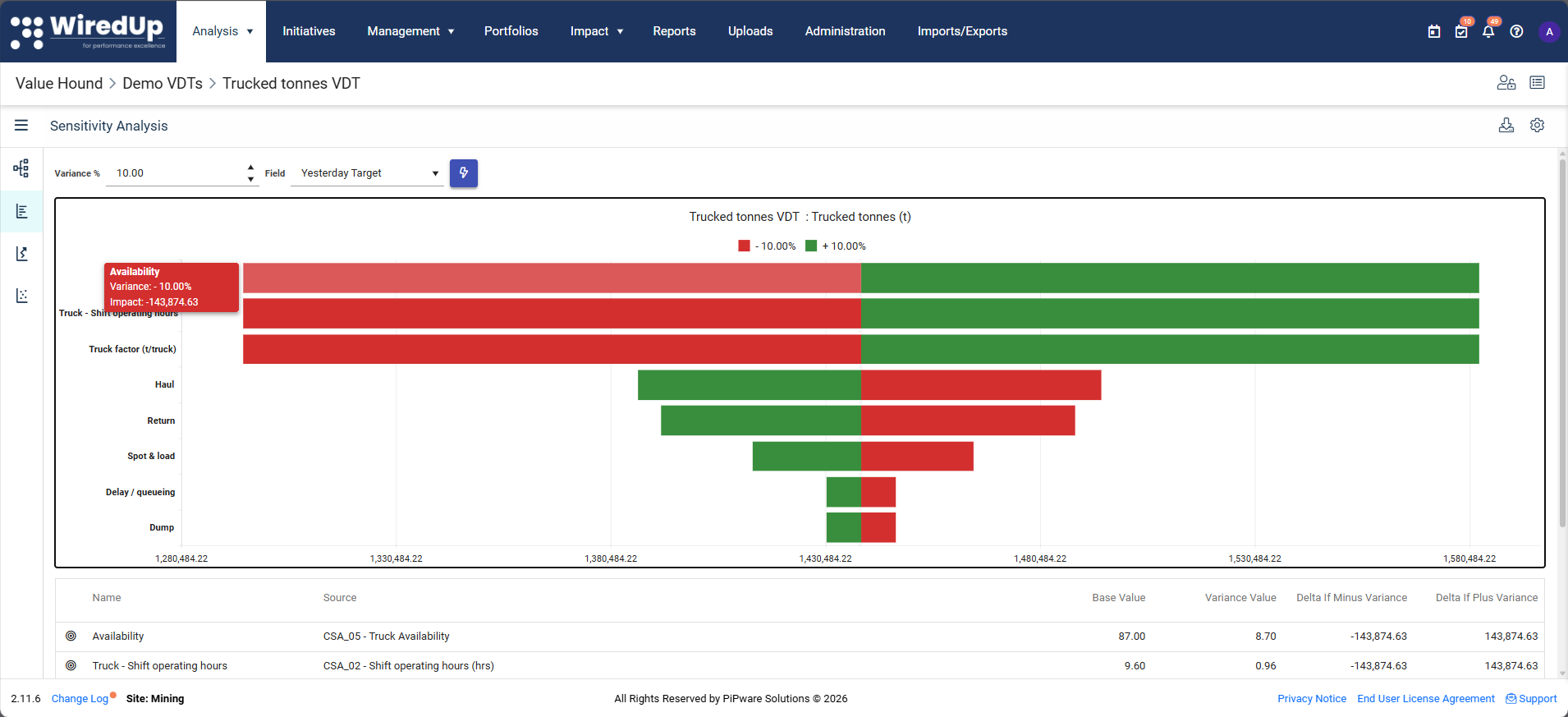
- A table showing the magnitude of impact for each KPI
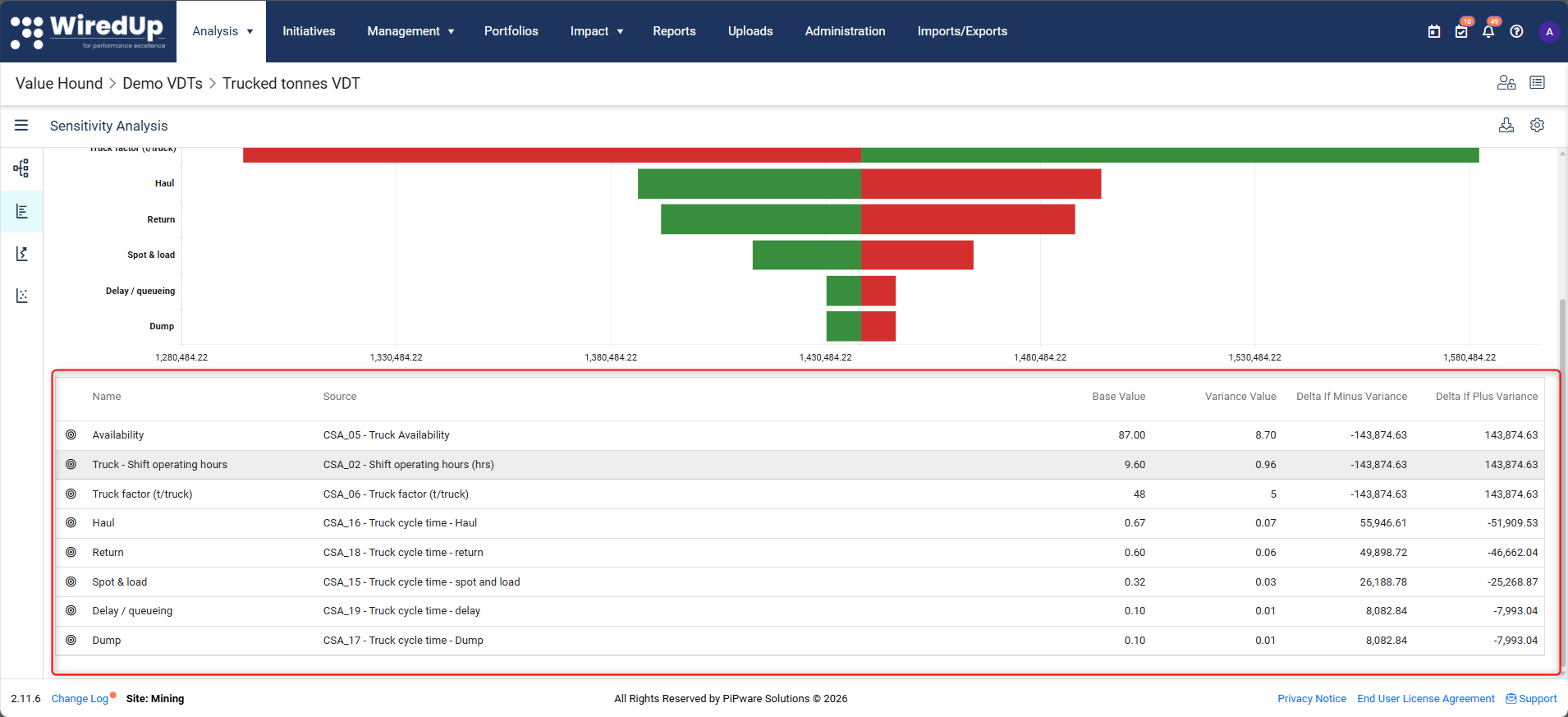
KPIs are ordered by their contribution to the outcome change when the variance is applied. A higher position indicates greater sensitivity of the outcome to that KPI.
Interpreting Positive and Negative Impact
The direction shown in Sensitivity Analysis reflects how the outcome changes when the KPI value is increased by the selected variance.
Important considerations:
- A negative impact does not mean the KPI is "bad"
- The direction reflects mathematical relationships, not performance quality
- Expected Trend settings influence visual indicators, not calculation logic
- Always interpret direction in the context of the KPI's role in the calculation
Why Some KPIs Rank Higher Than Others
A KPI may show high sensitivity because:
- It has a large absolute value
- It sits close to the outcome node in the tree
- It is multiplied or amplified through calculations
- It affects multiple branches of the tree
Sensitivity does not imply controllability — only impact.
How to Use Sensitivity Analysis
Sensitivity Analysis is most useful for:
- Identifying high-impact drivers
- Prioritising improvement efforts
- Guiding where to run deeper analysis
- Informing which KPIs warrant closer monitoring
It is commonly used as a starting point before Attribution or Variance analysis.
Common Misinterpretations to Avoid
- Treating sensitivity results as targets
- Assuming high sensitivity means poor performance
- Comparing sensitivity results across different VDTs without context
- Using sensitivity analysis to justify specific actions without further analysis
Sensitivity Analysis answers "what matters most?", not "what should we do?"
When to Use Sensitivity vs Other Analyses
Use Sensitivity Analysis when you want to:
- Understand relative importance
- Screen for key drivers
- Quickly assess model behaviour
Use Attribution Analysis when you want to:
- Understand why results differ from target
Use Variance Analysis when you want to:
- Test specific "what if" changes
What Happens Next
Once you understand which KPIs have the greatest impact on outcomes, you can move on to Attribution Analysis to understand why performance differs from expectations.
The next article explains how Attribution Analysis works and how to interpret its results.
Next Steps
To learn about Attribution Analysis, see: