
In This Article
What Attribution Analysis Does
What Attribution Analysis Does Not Do
Interpreting Positive and Negative Contributions
Why KPIs Contribute Differently
How to Use Attribution Analysis
Common Misinterpretations to Avoid
Overview
Attribution Analysis explains why performance differs between two sets of values by quantifying how much each KPI contributes to the difference in an outcome. It is typically used to understand the drivers behind missing or exceeding a target.
What Attribution Analysis Does
Attribution Analysis compares two fields in a Value Driver Tree, such as:
- Actual vs Target
- Actual vs Baseline
Each KPI is adjusted from the control field to the analysis field, and the resulting impact on the outcome is calculated.
The total difference between the two fields is fully allocated across contributing KPIs.
What Attribution Analysis Does Not Do
Attribution Analysis:
- Does not predict future performance
- Does not apply hypothetical changes
- Does not alter KPI data or targets
- Does not explain root causes on its own
It explains where variance comes from, not why it occurred.
Understanding the Output
Attribution Analysis typically displays:
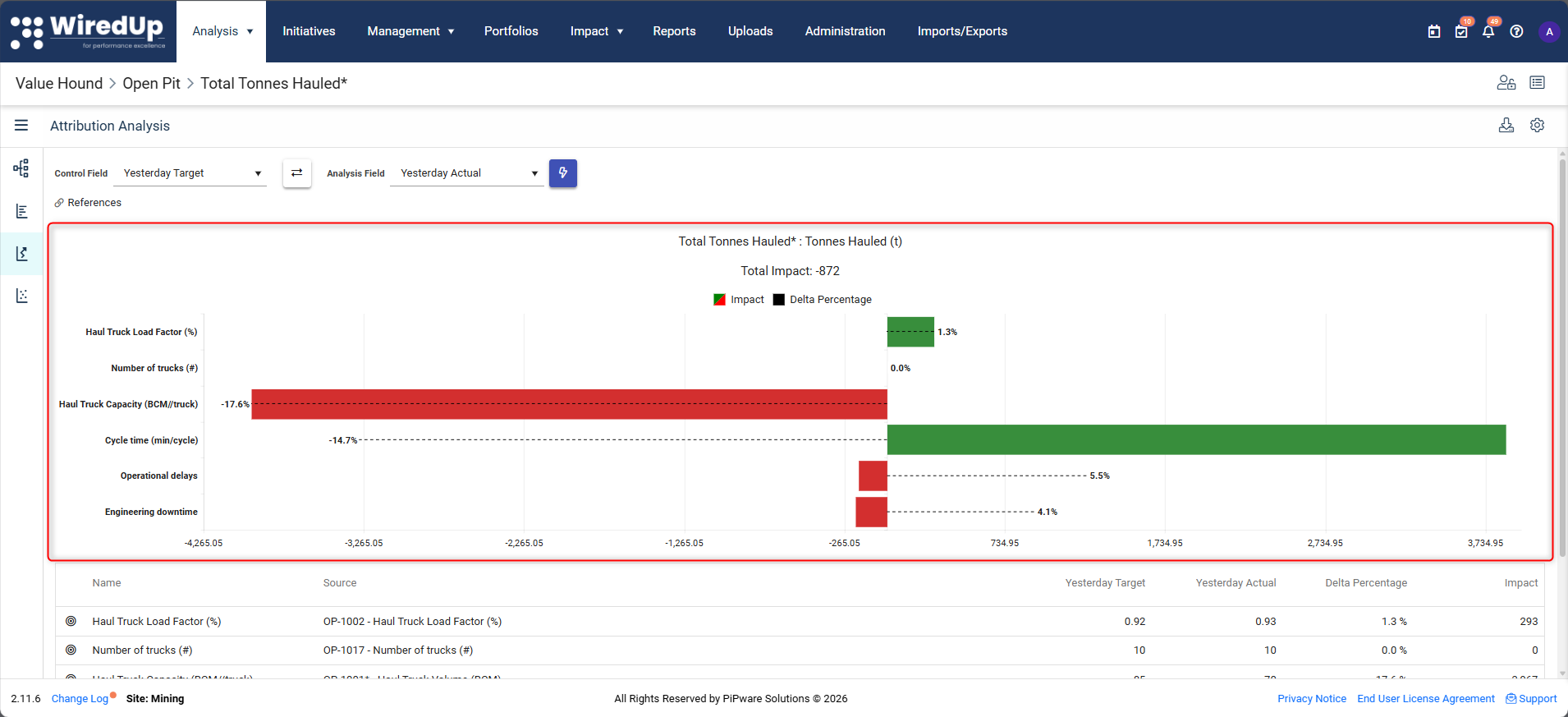
- A bar chart showing the contribution of each KPI
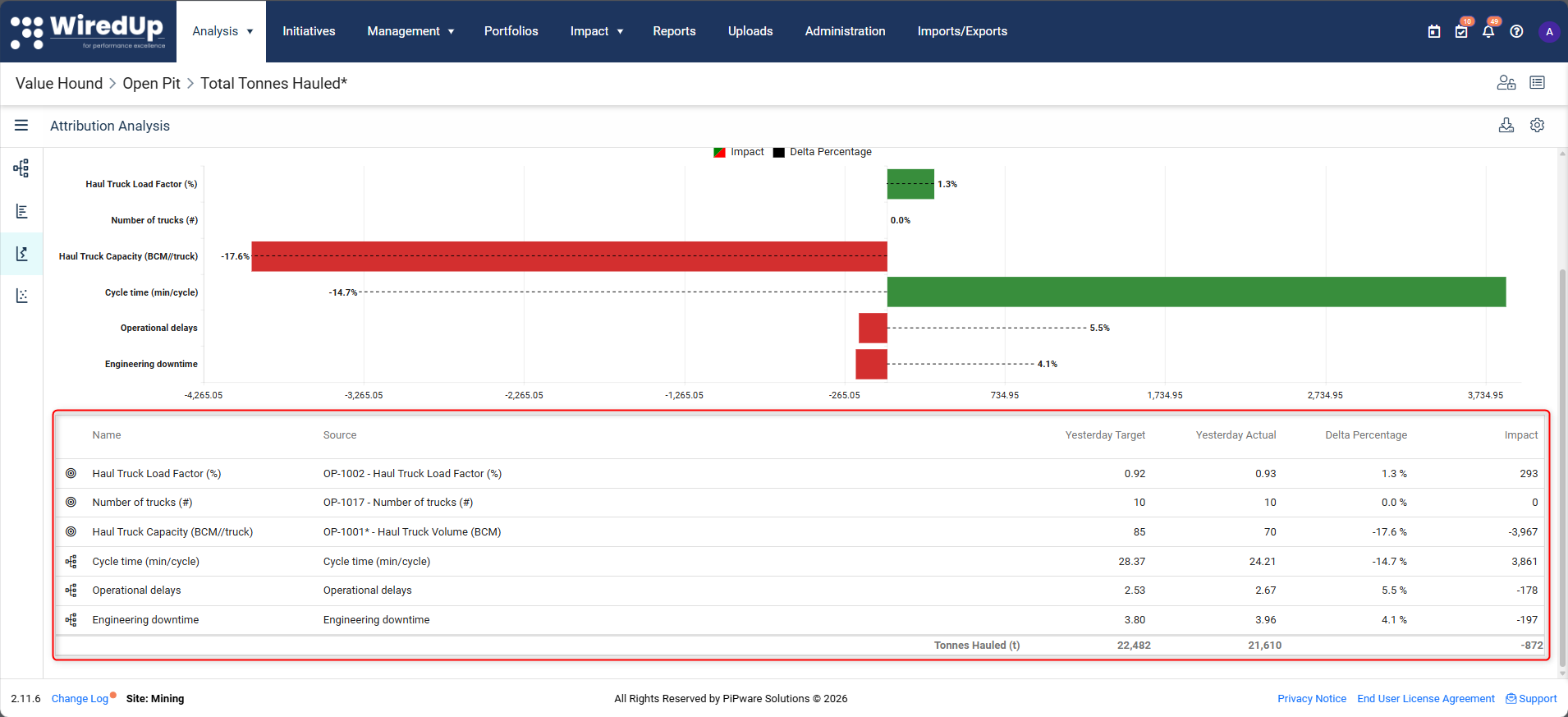
- A table detailing absolute and percentage impacts
- Each bar represents the impact of moving a KPI from the control value to the analysis value while holding other KPIs constant.
- The sum of all KPI contributions equals the total difference between the two fields at the outcome level.
Interpreting Positive and Negative Contributions
- A positive contribution indicates that a KPI moved the outcome towards the analysis field.
- A negative contribution indicates that a KPI moved the outcome away from the analysis field.
Important considerations:
- Contribution direction reflects mathematical impact, not KPI performance quality
- Expected Trend settings affect visual indicators but not attribution calculations
- A KPI can have a positive contribution even if its performance is below target, depending on the calculation structure
- Always interpret contributions in the context of the VDT logic
Why KPIs Contribute Differently
A KPI's contribution depends on:
- The magnitude of change between control and analysis values
- Its position in the Value Driver Tree
- How it interacts with other drivers in calculations
- Whether its effect is amplified or dampened by formulas
Attribution reflects impact, not effort or controllability.
How to Use Attribution Analysis
Attribution Analysis is useful for:
- Explaining performance outcomes to stakeholders
- Identifying the main drivers behind variance
- Supporting performance reviews and reporting
- Prioritising investigation areas
It is often used after Sensitivity Analysis to focus on the most important drivers.
Common Misinterpretations to Avoid
- Assuming attribution explains root cause
- Treating contributions as accountability assignments
- Ignoring structural effects in the model
- Comparing attribution results across different trees or periods without context
Attribution Analysis answers "what drove the difference?", not "who is responsible?"
Attribution vs Sensitivity
- Sensitivity Analysis shows which KPIs could have the biggest impact.
- Attribution Analysis shows which KPIs did drive the observed difference.
Both are complementary and should be used together.
What Happens Next
Once you understand which KPIs contributed to performance variance, you can use Variance Analysis to test specific changes or scenarios and quantify their potential impact.
The next article explains how Variance Analysis works and how to interpret scenario results.
Next Steps
To learn about Variance Analysis and scenarios, see: